Stability - the ability of the model not to tip over - is a function of hull design, and most models have ballast keels. Unlike many full-sized racing boats, centerboards are seldom found on racing models. Like full-size keel-boats, model yachts will sink if they fill with water. For this reason a fiberglass hull is a top choice for the beginner unless he has the skill to plank up a watertight hull. To insure that the hull stays dry inside so the model won't sink and, equally important, to keep the radio receiver and equipment dry, the hatch should be designed for easy removal and yet be sealed tight for sailing.
Within the hull space are: a standard radio-controlled receiver, batteries for the receiver, a sail winch for trimming the sails, batteries for the sail winch, and the two or more servo mechanisms which steer the boat and control the winch. Rechargeable batteries are in order, since the typical operation span of most systems is about one day's racing or two hours' continuous operation. Dry batteries have the disadvantage of needing frequent replacement (they are not rechargeable) but they offer the advantage of giving some warning that they are getting low since they drop slowly in voltage as they discharge. NiCds, although rechargeable, do drop suddenly in voltage once they get on the edge of discharge. One of the most common problems the model skipper encounters is the loss of battery power while his model is out on the pond. Very often what appears to be outside interference to the radio turns out to be low batteries in the radio-control system which causes the receiver to act weird.
Wednesday, June 28, 2006
Radio-controlled sailing model | The cost
As with any hobby-sport, the cost of the model yacht reflects its degree of sophistication. The market is supplied by a number of highly qualified one-man companies as well as by a handful of larger companies. This mix allows the modeler to choose top quality boats from a nominal $100 up. In general, the cost of model yachting parallels the cost of sport fishing and golf. While some models have a useful life of many years, others become obsolete in a year or two. (More about this later.) A good source of inexpensive models is the used-model marketplace. However, a large number of models of the same class or type being offered used at the same time may be a warning sign that there is something less desirable about that type of model.


Radio-controlled sailing model | How Large?
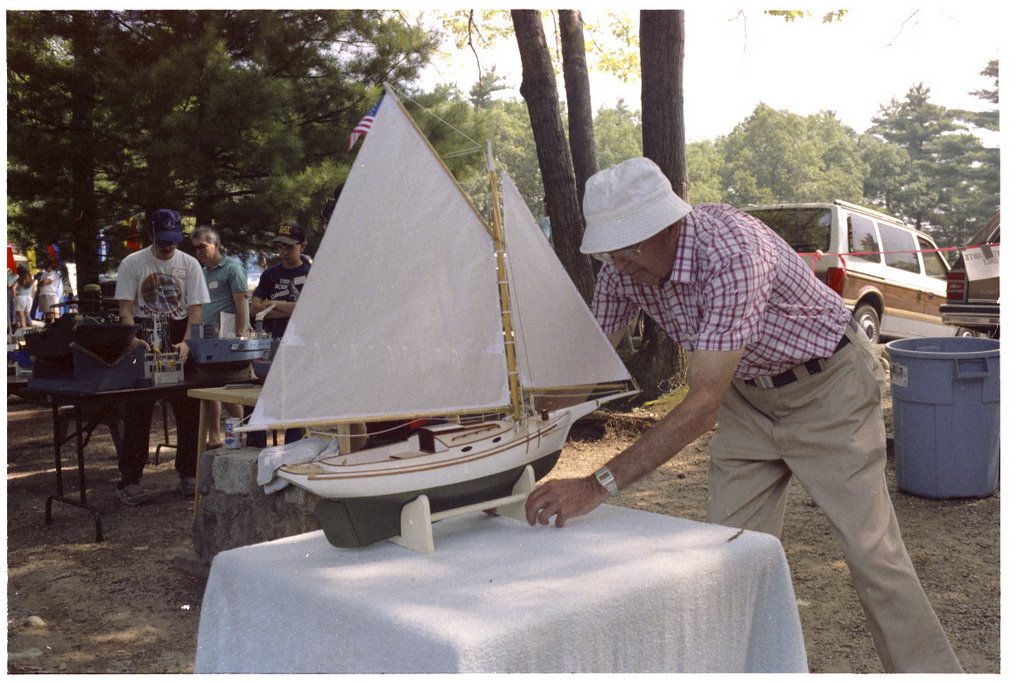

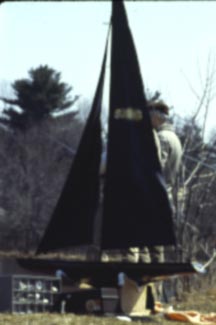

Almost without exception the uninitiated spectator who has been watching a model out sailing and then sees it being brought ashore will express great surprise at how big it is. That little model you see out on the pond can be eight feet long and weigh up to eighty pounds. Unless you sail in a swimming pool, the rule of thumb is: the larger the model, the easier to sail. And one of the most important considerations in selecting a model is its size, all other things being equal. If you cannot see the boat well enough to distinguish wind changes on the sails and reaction to the controls, you will be unable to operate it among a fleet of models sailing offshore. The distance to which we can sail our model yacht is limited not by range of the radio transmitter and receiver in the control system but by the capability of the human eye. Beyond a certain point we cannot see the boat well enough to set the sails properly. Visibility is crucial for setting sail trim and course - and also for avoiding collisions.
From a practical standpoint, the minimum overall length is 36 inches if you plan to sail with other larger models. The large "J" boats and "A" Class boats measuring eight feet in length represent the upper limit. Thirty nine to sixty inches constitute the most common hull lengths. In selecting your model size consider: where you will store the model when not in use; how you will transport it to the water's edge; what is involved in your launching it (depth of water required, weight of model, bulk of model, etc.). At the time of purchase you will need to consider the cost of having the model kit delivered to you. Generally, models up to 50 or 60 inches can be packed to ship by mail or United Parcel. Models which cannot be packed within UPS size and weight limitations must either be picked up personally at the shop or be shipped by truck. The same considerations must be given to the spars for your model. A tall one-piece mast may be very expensive to have shipped. If you overlook the shipping costs, you may find the shipping more costly than the model itself, unfortunate but sometimes true.
Sailing model weights range from five pounds to over 80 pounds. Fifty inch models will range from ten to 30 pounds, which is within the launching ability of most adults. The larger boats require a cart or two persons for launching.
While a child's toy boat can be launched from the edge of the pond, the size of the R/C models requires a launching area with water deep enough to allow for the depth of the model keel. The typical 50/800 Marblehead draws 15 to 18 inches. You may need to wade out into the water to launch and recover your model. At facilities for full-size boats, there is usually big-boat activity which wipes out model activity - model boats sail best undisturbed by powerboat wakes and water skiers! The Parks and Recreation Department in your town may be willing to follow the lead of the Town of Needham, Massachusetts, in providing model-boat facilities, particularly at ponds where other public access is restricted. Consider too the possible need to launch a small boat to recover a disabled R/C model.
The sails on the modern model racing yacht are left attached to the spars rather than furled or stowed as they would be on a big boat. In the normal home it may be hard to find space to stow away a ten-foot mast with sails attached.
Radio-controlled sailing model | Investment
A quality model can be an investment lasting for many years. Some modelers have models that have been passed along for a couple of generations. It is worh joining the AMYA, www.amya.org/ "The AMYA is devoted to promoting the designing, building, racing, and preservation of all model sailing yachts. We pursue these goals by recognizing certain Classes of Model Yachts, sanctioning model yacht Regattas, recognizing model Yacht Clubs, publishing a quarterly Model Yachting Magazine, and Promoting model yachting in general. Any operating model sailboat enthusiast will benefit by joining the AMYA and meeting others with the same interests."
Classification of models into classes for racing has been going on for years under the leadership of the Model Yacht Racing Association The AMYA has been very active in promoting the R/C racing of sailing models, and its leadership provides the format in interclub and national regattas. Not all classes are AMYA oriented. A manufacturer having a proprietary and top-notch model cannot be sanctioned by AMYA unless that manufacturer releases or arranges for other manufacturers of that model. This may be a questionable business decision for a manufacturer with an investment in his design and tooling.
Radio-controlled sailing model | AMYA yacht classes | "character" models, such as schooners and sloops
The yacht classes presented here are representative of the choices available to a modeler wanting to race with others. Not included are the several "character" models, such as schooners and sloops, which are available.
The oldest and most prominent classes are the "formula" classes. Rather than try and handicap differing models, a set of ground rules was established with a wide range of individual variation still possible between models. The largest fleet of racing models is to be found in the 50/800 or International Marblehead Class. This formula is quite simple and requires the model to have a mono-hull which is 50 inches long and to carry not more than 800 square inches of sail. A vast number of differing designs can be developed to fit the 50/800 formula. Many of the 50/800 models are oneof-a-kind scratchbuilt models. With the advent of fiberglass models, suppliers are able to mass-produce like hulls of one particular 50/800. Although these are mass-produced, the class rules still permit' a wide variety of rigging and unlimited modifications to these kit boats, so they do not constitute a one-design.
50/800 Marblehead class is very competitive. A particular model will win a number of races and become very popular only to become obsolete when a new boat is designed. This class races boat design against boat design, as well as sailing skills. Its biggest drawback is that the Marblehead skipper must resign himself to a new boat each year or two if he is to stay a winner.
The 36/600 is a smaller version of the 50/800 type formula. Hull type is unlimited, so there are some multihull 36/600 models. The biggest problem with this class is the visibility problem caused by the short 36 inch hull length. There are other formula classes, such as the "A" Class. "A" boats tend to be big and heavy and most are scratchbuilt. This class is popular among some very sophisticated racing persons who, though relatively few in number, take racing very seriously.
The best buys for the model owner may be found in the one-design classes. The distinguishing feature here is the requirement that all the models within each of the one-design classes must be identical. This feature prevents the model from becoming obsolete within its class because of age or because of some innovation being made in the boat design. The Star 45 Class is a one-design class with specifications resulting in significant performance differences between models. Which manufacturer or kit? Before deciding check the hull material.
Radio-controlled sailing model | Hull construction and Materials

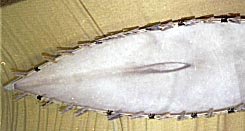
High-quality reinforced plastics such as fiberglass, carbon fiber, and other fiberglass like materials are excellent. Non-reinforced plastic kits may be hard to repair and be more prone to damage. The hull should have an exterior coating of gel-coat resin, and the glass weight should be specified. The glass should be saturated with resin, but a heavy dripping coating over the glass inside the model may indicate a hull which will be fragile when bumped, and the excess resin may make the hull excessively heavy.Deck. Many of the top rated model kits are supplied with a hull to which you attach the deck. This important joining of hull to deck may be difficult for the inexperienced model builder. Attaching a deck can change the shape of a model hull, so it will be recognized that a model with a factory-installed deck will probably have a closer fit to class specifications than one built up in the field.
Radio-controlled sailing model | Radio
Radio system. Two-channel control is the minimum, while models requiring multi-channel (up to seven) may be too difficult for many skippers to cope with. Be sure that the control system includes the sail winch when you price things out. While you can save some cost by purchasing dry battery system, the initial cost of a rechargeable battery is more than paid for if you sail frequently and want the ability to have fresh batteries each time.
Radio-controlled sailing model | Ballast and Keel Bulbs

Ballast: Many modelers are shocked to find how difficult and costly it can be to get lead shot. When you need five or ten pounds of shot and must pay for shipping 25 pounds, it can make the relative cost of the model higher than that of a competitive model with ballast included. Cast-lead ballast keels are generally superior to buckshot-filled keels.
Radio-controlled sailing model | Fittings and Rigging
Fittings. Examine the fitting requirements of your model. It can be an expensive proposition if the rig is complicated.
Radio-controlled sailing model | Masts
Masts. Masts run the gamut from simple wood spars to slotted aluminum through carbon fiber shafts. From a time-of-assembly standpoint, aluminum mast is excellent. For salt-water sailing, however, you will need the anodized aluminum.
Radio-controlled sailing model | Sails
Sails. The cost of professionally made sails from such lofts as Carr Sails is a fact of life if you plan to race seriously. Cotton and nylon sailcloth is totally inadequate compared to Dacron and other synthetic sailcloths.
Radio-controlled sailing model | Sail Winches

Sail winches. A winch mechanism will be required for any model where you will be sheeting in 600 square inches or more. A large model, while maneuvering and changing course, can put a heavy pulling load on the sail winch, plus innumerable shock loads when the sails yank on the sheets. There are two popular winch configurations and two types of drive mechanism. The drum or loop configuration trims the sail by winding the sheet or a loop about a drum mounted on the shaft of a gear motor. The swing-arm configuration is very popular. In this, the sheets from the sails are attached to a long arm mounted on the shaft of a gear motor. The swing-arm configuration is very popular. In this, the sheets from the sails are attached to a long arm mounted on the gear-motor; as the arm is rotated it either pulls in the sheets or releases them. The two drive mechanisms are the switch-operated gear-motor and the proportionally controlled or "proportional winch." The switch of the gear-motor is linked to the sail servo and the motor is turned on and off as well as reversed by the switch position. The position of the transmitter control is not related to the position of the sails. The proportional sail winch has electronics similar to those in a servo, which in effect turn the gear-motor into a very high-power servo. With the proportional winch, the position of the winch and the sails is proportional and directly related to the position of the control on the transmitter.
Radio-controlled sailing model | What next

There is one great difference between radio-controlled model boats and radio-controlled aircraft. It is very difficult for even a rank novice to do harm to a sailing model while sailing it. Therefore the prospective purchaser will be sure to find a number of local R/C skippers who will let him have a try at sailing their boats when asked. Ask about at your local shops, park departments, and newspapers, and you will be able to locate the local yachtsman sailing his R/C craft at some nearby spot. Stop by and watch him, ask advice, and get to sail a model or two.
I first Published this in 1979 in the Scale Ship Modeler. A few dated references have been edited or removed. Comments and up-dates are welcomed.
Wednesday, March 01, 2006
list of museums
The following lists of museums cover different parts of the world and vary in the amount of information provided about each museum.
* World-wide museums - this list by Lars Bruzelius is organized by continent, then alphabetically by country, state or province (in the US and Canada), then by city.
* Robert H. Smith's Master Index to North American Maritime Museum Internet Resource provides an excellent guide to maritime museum internet sites. The museums are organized alphabetically by name, however, so finding museums in the places you're headed can take a while.
* Fishery Museums is a nice description of various Scottish and English museums highlighting fisheries. The page is part of Fish Tales, dedicated to fishing in the Faroe Islands.
* Greek maritime museums are listed here, with photographs and information in English about many 'nautical museums' in Greece.
Many maritime museums have established sites on the Internet, and many others are in the process of doing so. Those which already have sites include the following:
* Mystic Seaport, the "Museum of America and the Sea," in Mystic, Connecticut. This is a wonderful museum; anyone with half an interest in maritime history should spend a day or two every year visiting the museum.
* Britain's National Maritime Museum is truly one of the world's great maritime museums, and every exhibit they present is fascinating. When visiting the museum, I suggest taking the Docklands Light Rail to the Greenwich stop and walking through the tunnel under the Thames, then taking a boat on the Thames back to the Houses of Parliament, or vice versa.
* The San Francisco Maritime National Historical Park is an interesting museum by the Bay. For some reason there's no links from this page to the Park's other pages, such as one describing the Museum Collection Profile. The inaccurately named National Maritime Museum Association supports the SFMNHP, and has created another home page for the San Francisco park.
* The San Diego Maritime Museum, home of the Star of India, has a nice web site.
* The Maritime Museum of the Pacific is currently under construction in Kailua-Kona, Hawaii.
* The Santa Barbara Maritime Museum plans to open in the summer of 1999, but its virtual version is already open here.
* The Kendall Whaling Museum in Sharon, Massachusetts, has a nice home page, with a variety of sources and bibliographies on whaling.
* The Mariners' Museum in Newport News, Virginia. The Mariners' Museum has one of the best maritime research libraries in the country.
* South Street Seaport Museum in New York City now has a web site; the museum is home to the massive Peking.
* The Maritime Arts and History Collection is one of the strongest parts of The Peabody Essex Museum in Salem, Massachusetts.
* The Texas Seaport Museum, in Galveston, Texas, keeps Elissa afloat and sailing.
* The United States Naval and Shipbuilding Museum in Quincy, Massachusetts, is home of USS Salem (CA 139), the world's only preserved heavy cruiser.
* The Penobscot Marine Museum in Searsport, Maine, has a very nice and informative site.
* The Center for Wooden Boats in Seattle, Washington, is a great resource for wooden boat builders and afficionados.
* The Elisha Kent Kane Historical Society in New York City strives to be a clearinghouse for information on Arctic exploration.
* The Nantucket Lifesaving Museum on Nantucket Island, Massachussets, off Cape Cod, is another lifesaving museum, with a number of valuable artifacts.
* North Carolina Maritime Museum (NCMM) in Beaufort, North Carolina, is a remarkable museum in a beautiful and historic small town.
* Southport Maritime Museum, in Southport, NC.
* The Catalina Island Museum on Catalina Island, off Los Angeles.
* The Hart Nautical Collections at the MIT Museum in Cambridge, Massachusetts, focus on "the technical history of New England ship and small craft design and construction from the 19th through mid 20th centuries."
* The Steamer William G. Mather Museum Homepage includes information on this 1925 Great Lakes Bulk freighter, plus links to the Association for Great Lakes Maritime History, based in Bowling Green, Ohio.
* Nauticus, the National Maritime Center, in Norfolk, Virginia, has returned to the Web in a graphic-intensive, slow-loading version.
* The Texas Marine Department, Confederate States Navy, have information about the Confederate States Navy, including a nice discussion about the ships of the Confederate States Navy.
* Chesapeake Bay Museum in St. Michaels, Maryland.
* Long Island Maritime Museum in West Sayville, New York.
* The Connecticut River Museum, in Essex, Connecticut.
* Apalachicola Maritime Museum, in Apalachicola, Florida.
* Maritime Museum of the Atlantic and the Fisherman's Life Museum are both members of the Nova Scotia Museum and are located in Nova Scotia.
* The Yarmouth County Museum & Archives, located in Yarmouth, Nova Scotia, explores Yarmouth's past, particularly its shipping industry. A nonframes version is also available.
* Fisheries Museum of the Atlantic, in Lunenburg, Nova Scotia, is also a member of the Nova Scotia Museum group. This is another fascinating museum in a great small town.
* Maritime Museum of British Columbia in Victoria, British Columbia.
* The Marine Museum of the Great Lakes in Kingston, Ontario.
* The Naval Museum of Alberta in Calgary, Alberta.
* The Mary Rose Virtual Maritime Museum describes Henry VIII's warship Mary Rose, lost in 1545 and raised in 1982. This is a remarkable web site.
* The Merseyside Maritime Museum in Liverpool, England, highlights the dramatic role played by Liverpool's revolutionary dock system in the city's development as a major trading site.
* The Royal Greenwich Observatory is not strictly a maritime history museum, but nevertheless has fascinating exhibits which focus on the importance of timekeeping and accurate observation to mariners. And, of course, it's just up the hill from Britain's National Maritime Museum. Greenwich 2000 promotes the area, and has some interesting travel and tourist information.
* The Exeter Maritime Museum, in Exeter, England.
* The Maritime Museum (Sheepvaart museum), of Amsterdam.
* The Vasa Museum, in Stockholm, presents the recovered remains of the 1628 royal warship Vasa, which sank on its maiden voyage and was discovered in 1956.
* The Hellenic Maritime Museum, in Piraeus, Greece.
* Western Australia Maritime Museum in Fremantle, Australia. Access to this site varies. Keep trying.
* The Sydney Heritage Fleet is Sydney's oldest maritime museum.
* The Windermere Steamboat Museum in England's Lake District clearly ranks, in my opinion, among the best maritime museums in the world. After some time without a web page, the museum now has several: here's a page about the museum sponsored by TARS, The Arthur Ransome Society.
* The Navy Museum, in Brest, France.
This collection of pages was created by Peter McCracken, mccrp@ils.unc.edu.
This document was last modified 20 April 1999.
Vessel images and definitions on the pages within are provided through the courtesy of
American Sail Training Association
P.O. Box 1459, Newport, Rhode Island, 02840.
Telephone/fax: (401) 846-1775; email: asta@sailtraining.org
Saturday, October 15, 2005
NORTH CAROLINA BATTLESHIP, NORTH CAROLINA CLASS, BB-55
Homeport:
Current Use:
Original Use:
Contact: North CarolinaWILMINGTON, NC
MUSEUM VESSEL (FLOATING EXHIBIT)
COMBATANT
U.S.S. NORTH CAROLINA BATTLESHIP COMMITTEE
P.O. BOX 480
WILMINGTON, NC 28402
910-251-5797
Built: 1941, BROOKLYN NAVY YARD, BROOKLYN, NEW YORK. Length: 728.9, Beam: 108.3, Draft: 35, Displacement: 36600. Hull: STEEL. Preservation Status: GOOD CONDITION, 95% ORIGINAL FABRIC, LISTED ON THE NATIONAL REGISTER OF HISTORIC PLACES, REF. NO. 81000424, DESIGNATED A NATIONAL HISTORIC LANDMARK, 1/14/86.
Tuesday, September 13, 2005




Tuesday, March 22, 2005
Classic Friendship Sloop - R/C Sailing Models


Billy Hogan with his Friendship Sloop.
January 2005
kit was circa 1971 from Dave Mainwaring
They make a beautiful R/C sailing model
see Dave's models on this Blog.
Posted by Hello
Monday, March 14, 2005

Dave Mainwaring's R/C Friendship Sloop,
medium size models make nice display models
jpg014a
Posted by Hello


Friday, March 11, 2005


Radio Control Sail Boats
Cyberspace Model Yacht Club
focusing on Radio Controlled Model Boats,RC_Modelboats@mainzone.com
www.mainzone.com
A on line email list serv R/C Model Boating Forum, courtesy of Dave Mainwaring
Membership is open to anyone interested in Radio Controlled Models powered by Sail, Steam or Electric power. Marine Modelers, Scale and Semi-scale Model Boat Builders, Radio Control Sail Boats of all types. Membership is free!
Subscribe to:
Posts (Atom)